
Animal Feed Storage: A Complete Guide for Farmers to Protect Feed Quality and Reduce Wastage
In this article
For a livestock farmer, purchasing good-quality animal feed is an important investment. But buying quality feed is only the first step. How that feed is stored on the farm can have a major impact on its condition, cleanliness, safety, and overall usability.
Many farmers give considerable attention to selecting cattle feed, dairy feed, goat feed, poultry feed, or other livestock feed, but may not pay the same attention to storage. Feed bags may be kept wherever space is available, sometimes directly on the floor, near water sources, or in areas exposed to moisture and pests.
Poor storage can lead to unnecessary feed losses and may create avoidable problems in day-to-day livestock management.
Proper animal feed storage does not have to be complicated. With a clean, dry, organized and protected storage area, farmers can take simple steps to protect their feed and reduce unnecessary wastage.
This guide explains practical feed storage practices that every livestock farmer should know.
Why Proper Animal Feed Storage Is Important
Feed is an important part of farm expenses. Every bag of feed purchased represents an investment in the animals and the farm.
When feed is stored poorly, several problems can occur.
Feed may be exposed to:
- Moisture
- Rainwater
- Humidity
- Dust
- Rodents
- Insects
- Birds
- Other pests
- Dirt
- Chemicals
- Direct contamination
These problems can affect the condition of stored feed and increase wastage.
For example, a bag that becomes wet may not remain in the same condition as properly stored feed. Similarly, feed contaminated by pests or chemicals may no longer be suitable for use.
Therefore, farmers should think of storage as an important part of the complete feeding process.
Good feed management starts from the moment the feed reaches the farm.
1. Choose the Right Location for Feed Storage
The first step in proper livestock feed storage is choosing a suitable location.
A feed storage area should ideally be:
- Dry
- Clean
- Well ventilated
- Protected from rain
- Protected from direct water exposure
- Away from chemicals and pesticides
- Protected from rodents and insects
- Easy to clean
- Easy to inspect
The storage area should not be located where water regularly collects.
Farmers should also avoid storing feed near leaking roofs, open drains, water tanks, or places where animals can knock over containers.
A simple rule is:
If the area is not suitable for storing dry food safely, it is probably not suitable for storing animal feed either.
2. Never Keep Feed Bags Directly on a Wet Floor
One of the most important rules of animal feed storage is to protect feed bags from floor moisture.
Even if the floor looks dry, moisture can sometimes move through the floor, especially during humid or rainy conditions.
Farmers can use suitable pallets, racks, platforms, or other raised arrangements to keep bags above the floor.
This helps:
- Reduce contact with moisture
- Improve air circulation
- Make cleaning easier
- Make inspection easier
- Protect packaging from floor contamination
Keeping feed raised from the floor is a simple habit that can make storage more organized and manageable.
3. Protect Feed From Rain and Water
Water is one of the biggest concerns when storing feed.
Farmers should regularly check the storage building for:
- Roof leaks
- Wall seepage
- Open windows exposed to rain
- Water pipes
- Leaking containers
- Flooding or water accumulation
During the rainy season, these checks become even more important.
Do not assume that because the feed room is indoors, the feed is automatically protected.
Inspect the area after heavy rainfall and look for signs of moisture.
If a bag has become wet or damaged, farmers should follow appropriate product guidance rather than automatically mixing potentially affected feed with good stock.
4. Keep the Storage Area Clean
A clean storage area is essential for proper feed management.
Dust, spilled feed, old packaging and waste can attract pests and make it difficult to identify storage problems.
Farmers should establish a simple cleaning routine.
Regularly:
- Sweep the floor
- Remove spilled feed
- Dispose of damaged packaging appropriately
- Clean storage surfaces
- Check corners for pest activity
- Keep unnecessary materials away from feed
The storage area should be used primarily for feed rather than becoming a general-purpose room for farm equipment.
A clean and organized storage area makes it easier to monitor the condition of feed.
5. Keep Feed Away From Chemicals
Animal feed should never be stored together with chemicals such as:
- Pesticides
- Herbicides
- Fertilizers
- Disinfectants
- Fuels
- Oils
- Veterinary chemicals
Even accidental spills can create serious contamination concerns.
Farmers should maintain a separate storage area for chemicals and other potentially hazardous materials.
The principle is simple:
Food for animals should be stored separately from chemicals used around the farm.
This is especially important on farms where multiple materials are stored in the same building.
6. Protect Feed From Rodents
Rodents can become a major problem in feed storage areas.
They may damage bags, consume feed, contaminate storage areas, and create additional cleaning problems.
Farmers should regularly inspect the storage area for signs of rodent activity.
Look for:
- Damaged bags
- Droppings
- Gnaw marks
- Holes
- Nesting material
- Feed scattered around the storage area
Farmers should focus on preventing access to the storage area by maintaining clean surroundings and sealing unnecessary openings where practical.
Any pest-control programme should be handled carefully so that pest-control products do not come into contact with animal feed.
Never place potentially hazardous pest-control substances where animals or feed can be exposed to them.
7. Protect Feed From Insects and Other Pests
Rodents are not the only concern.
Insects and other pests can also become a problem in stored feed.
A clean, dry and well-managed storage area can help reduce the conditions that attract pests.
Farmers should inspect stored bags regularly rather than waiting until a problem becomes obvious.
If you notice unusual insects, damaged packaging, or other signs of infestation, isolate the affected stock and seek appropriate advice on how it should be handled.
Do not simply mix questionable feed with unaffected stock.
8. Check Feed Bags Before Storage
When new feed arrives at the farm, do not immediately place every bag into storage without inspection.
Take a moment to check:
- Is the packaging intact?
- Is the bag torn?
- Is there visible moisture?
- Is there unusual contamination?
- Is the product information readable?
- Is the bag properly sealed?
Damaged bags should be handled according to the manufacturer’s instructions.
This simple inspection can prevent a damaged bag from creating problems for the rest of the stored feed.
9. Organize Feed Properly
Good organization makes feed management much easier.
Instead of randomly stacking bags, arrange them so farmers can easily identify:
- Different feed types
- Different animal categories
- Older and newer stock
- Product batches
- Damaged or questionable bags
For example, a dairy farm may have different products for different animals or production stages.
Keeping them clearly separated can reduce the risk of accidentally providing the wrong feed.
A well-organized storage room also saves time during daily feeding.
10. Follow a Proper Stock Rotation System
Farmers should avoid allowing older feed to remain forgotten at the back of the storage room.
When new stock arrives, organize the storage area so that older suitable stock can be used appropriately first, while still following the manufacturer’s storage and product-date guidance.
This approach is commonly described as stock rotation.
A simple system is:
Older suitable stock → Use first
Newer stock → Place behind or separately
This can help farmers reduce unnecessary losses from forgotten or improperly stored stock.
11. Pay Attention to Humidity and Ventilation
A storage room does not need to be excessively hot or humid.
Good ventilation can help maintain a more suitable storage environment.
Farmers should avoid creating a storage room where air remains trapped and moisture accumulates.
However, ventilation should also be managed so that rainwater cannot enter directly.
The objective is to maintain a clean, dry and appropriately ventilated environment according to the feed manufacturer’s storage recommendations.
12. Do Not Store Feed Near Animal Waste
Feed storage should be kept away from manure, waste and other sources of contamination.
Farmers should avoid storing feed bags next to:
- Manure piles
- Waste bins
- Dirty bedding
- Drainage areas
- Animal waste collection points
This is especially important on smaller farms where storage space may be limited.
If space is restricted, farmers should still create as much separation as reasonably possible between feed and waste areas.
13. Inspect Stored Feed Regularly
Feed storage is not a task that should be completed once and forgotten.
Farmers should inspect stored feed regularly.
During inspection, check for:
- Damaged bags
- Moisture
- Unusual smell
- Pest activity
- Discoloration
- Signs of contamination
- Poor storage conditions
Regular inspection helps identify problems early.
A small leak discovered today can be fixed easily. The same leak ignored for several weeks may damage multiple bags.
Regular observation is one of the simplest tools in good farm management.
14. Keep Feed Storage Records
For larger livestock farms, keeping simple records can improve feed management.
Farmers can record:
- Date feed was purchased
- Product name
- Quantity purchased
- Batch information where relevant
- Storage location
- Date stock was opened
- Quantity used
These records can help farmers understand how much feed the farm consumes and plan future purchases.
They can also help identify unusual changes in feed consumption.
For example, if a farm normally uses a particular amount of feed but suddenly begins using significantly more, the farmer can investigate the reason.
15. Store Different Feeds Separately When Necessary
A farm may use several types of feed.
For example, a dairy farm may have different feeds for different animal groups.
If different products are stored together without proper identification, mistakes can occur.
Farmers should clearly identify different feed types and keep them organized.
Labels should remain visible whenever possible.
This is especially important when multiple workers are responsible for feeding.
Everyone involved should know:
Which feed belongs to which animal?
16. Feed Storage Is Also Part of Dairy Farm Management
For dairy farmers, proper cattle feed storage is especially important because feed is a regular and significant farm input.
Dairy animals may receive different feeds depending on whether they are:
- Calves
- Heifers
- Pregnant
- Dry
- Lactating
- High-producing
Keeping these feeds properly organized can make daily dairy farm operations more efficient.
Farmers should ensure that the feed intended for one group is not accidentally given to another group.
Good storage supports good feeding management.
17. Train Everyone Who Handles Feed
On many farms, feeding is not handled by one person alone.
If several workers handle animal feed, everyone should understand the basic storage rules.
They should know:
- Where feed should be stored
- How bags should be arranged
- Which feed belongs to which animal
- How damaged bags should be reported
- How to identify signs of moisture or pests
- Why chemicals must be kept away
- How to maintain cleanliness
Even the best storage system can fail if people do not follow it consistently.
A Simple Daily Animal Feed Storage Checklist
Farmers can use this quick checklist:
Storage Area
- Is the storage area dry?
- Is the floor clean?
- Is the area protected from rain?
- Is there good ventilation?
Feed Bags
- Are bags raised above the floor?
- Are bags dry and undamaged?
- Are different feed products clearly identified?
Pest Protection
- Are there signs of rodents?
- Are there signs of insects?
- Are storage areas free from unnecessary waste?
Safety
- Is feed stored away from chemicals?
- Is feed protected from manure and other contamination?
Stock Management
- Are older suitable stocks being used appropriately?
- Are product details and dates being checked?
- Are damaged or questionable bags separated?
- A few minutes of checking can prevent much larger storage problems later.
Common Animal Feed Storage Mistakes Farmers Should Avoid
Here are some common mistakes that can affect feed storage:
Mistake 1: Keeping Bags Directly on the Floor
This can expose bags to floor moisture and contamination.
Mistake 2: Storing Feed Near Chemicals
Chemical contamination can create serious safety concerns.
Mistake 3: Ignoring Small Roof Leaks
A small leak can damage multiple bags over time.
Mistake 4: Keeping the Storage Area Dirty
Poor cleanliness can attract pests.
Mistake 5: Mixing Different Feeds Without Identification
This can increase the risk of feeding the wrong product to animals.
Mistake 6: Never Inspecting Stored Feed
Problems can grow when they are not noticed early.
Mistake 7: Overstocking Without Proper Storage Space
Buying more feed than can be properly stored can increase the risk of damage and wastage.
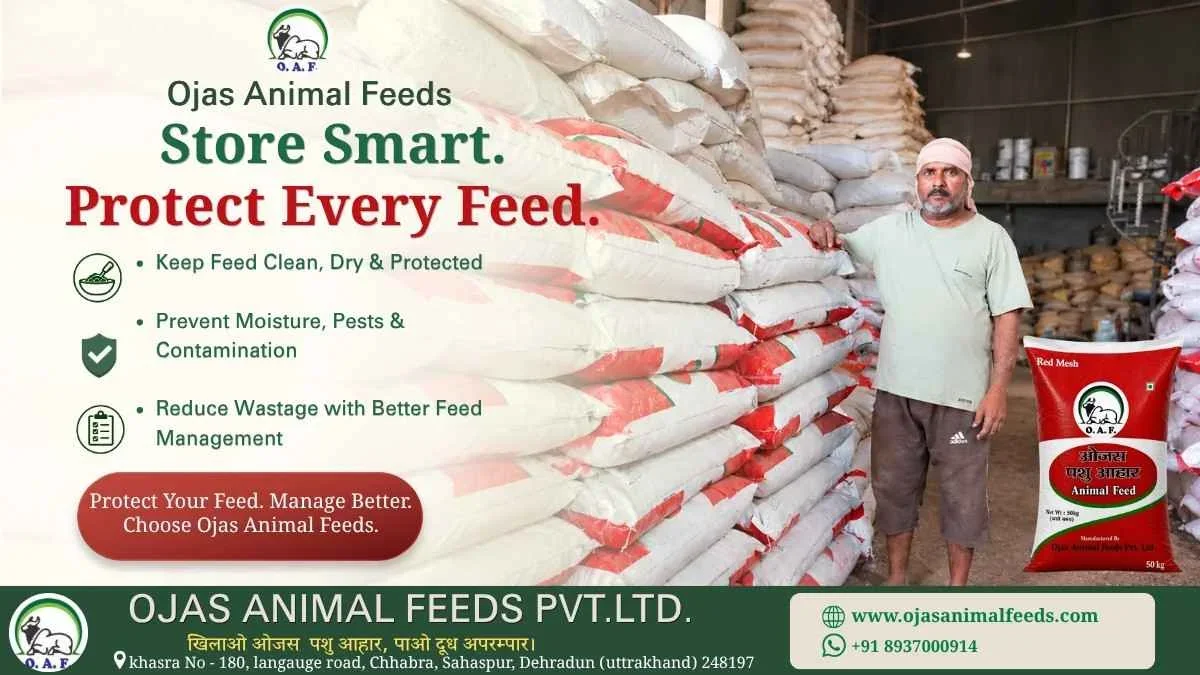
Ojas Animal Feeds: Better Feed Management Starts With Proper Storage
Ojas Animal Feeds focuses on providing feed solutions for farm animals while encouraging farmers to follow responsible animal nutrition and livestock management practices.
But farmers should remember that selecting quality animal feed is only one part of good feeding management.
How the feed is transported, stored, handled and provided to animals also matters.
Whether you are managing cattle, goats, horses, swine, poultry, sheep, rabbits, or other livestock, proper storage can help you protect your feed investment and maintain a more organized feeding system.
The principle is simple:
Buy responsibly. Store properly. Feed carefully. Observe daily.
Conclusion
Proper animal feed storage is an important but sometimes overlooked part of livestock farming.
Farmers invest money in feed, so protecting that investment should be part of everyday farm management.
A good storage system does not require expensive equipment. It requires consistent habits.
Keep feed dry.
Keep it clean.
Keep it raised from the floor.
Protect it from rain and moisture.
Keep it away from chemicals.
Control access by pests.
Inspect bags regularly.
Organize different feeds properly.
Rotate suitable stock appropriately.
And maintain a clean, well-managed storage area.
These simple practices can help reduce unnecessary feed wastage and make daily feeding more efficient.
Remember, good animal nutrition begins before the feed reaches the animal.
The way feed is stored can be just as important as the way it is selected and provided.
For every farmer, the goal should be simple:
Protect the feed. Reduce wastage. Feed responsibly. Manage the farm better.
Ojas Animal Feeds
Feed Better. Manage Better. Choose Ojas Animal Feeds.