
From Service to Enterprise: NIESBUD Trainees Explore New Beginnings at Ojas Animal Feeds
In this article
As Army personnel prepare for life beyond uniform, a visit to Ojas Animal Feeds offers a closer look at entrepreneurship, specialised animal nutrition, and the possibilities of a second career.
A uniform may eventually be set aside, but the discipline, leadership and experience earned over decades of service do not retire with it.
For members of the Armed Forces approaching retirement, the transition to civilian life often brings a question that is both practical and deeply personal: What comes next?
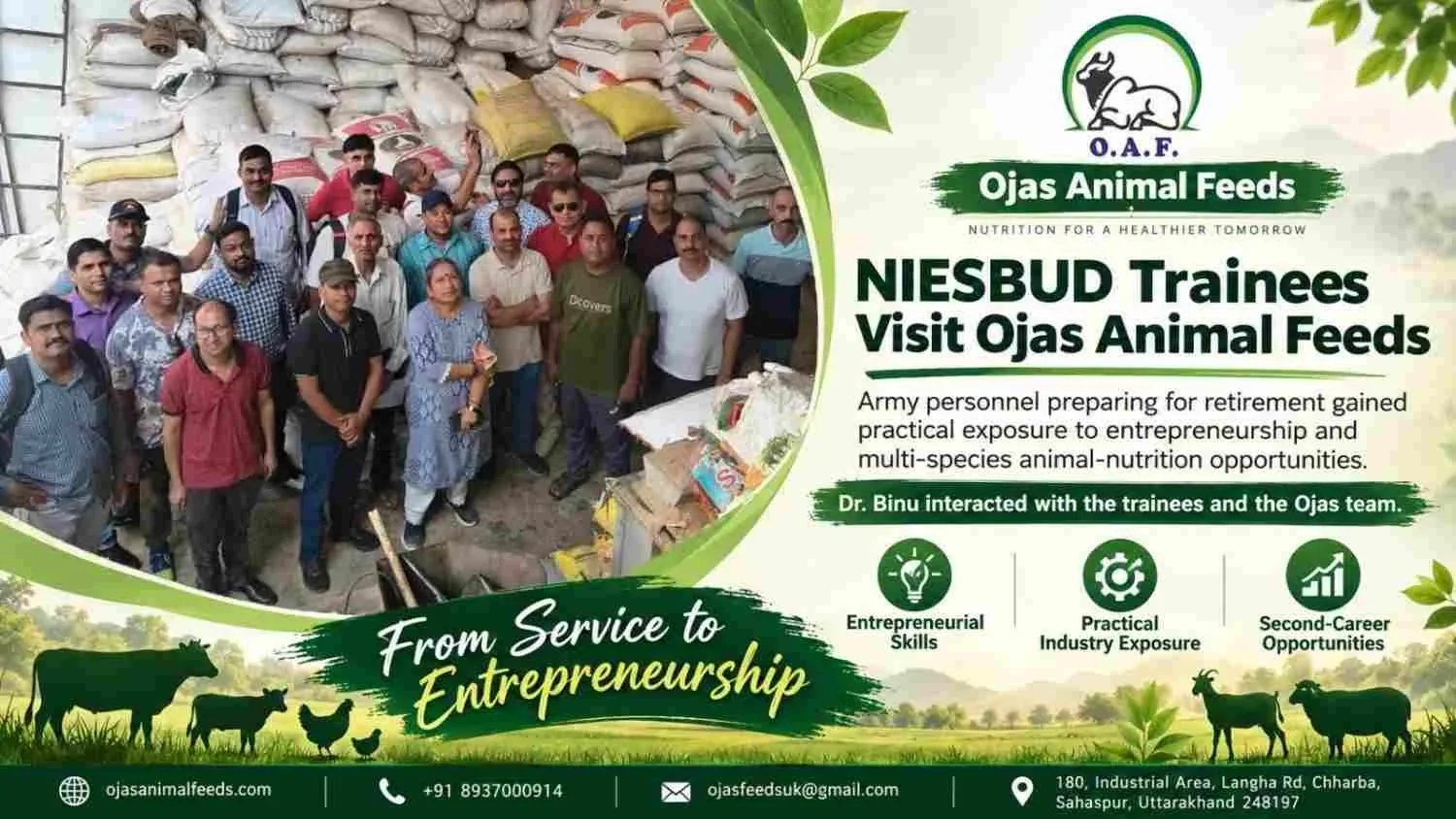
For a group of Army personnel undergoing entrepreneurship training with NIESBUD — the National Institute for Entrepreneurship and Small Business Development — one answer began to take shape during a recent visit to Ojas Animal Feeds Pvt. Ltd.
The visit was not simply an industrial tour. It was an opportunity to step inside a working enterprise, understand the decisions that sustain it, interact with people who have travelled the entrepreneurial road themselves, and explore how knowledge and experience can be transformed into a new professional identity.
At Ojas, that conversation naturally unfolded around animal nutrition. But the larger lesson extended well beyond feed.
It was about recognising opportunity.
It was about learning how a problem becomes a business idea.
And, perhaps most importantly, it was about understanding that a second career does not mean beginning again from nothing.
When Experience Becomes an Asset
People approaching retirement after years in the Army carry with them an extraordinary professional foundation.
They have worked within demanding systems. They understand planning, responsibility and accountability. They have led teams, managed resources, responded to uncertainty and learnt to make decisions under pressure.
Entrepreneurship requires many of the same qualities, but applies them in a very different setting.
There is no established system waiting for the entrepreneur. The entrepreneur has to build the system.
The product has to be understood. Customers have to be found. Costs have to be managed. Suppliers have to be coordinated. Markets have to be studied. A team has to be created. Decisions have to be taken without always knowing in advance whether they will succeed.
For professionals accustomed to structured service, seeing these realities firsthand can be far more valuable than simply reading about them.
That was what made the Ojas visit meaningful.
The trainees were able to observe a business in operation and understand that an enterprise is not created by one dramatic decision. It grows through hundreds of smaller decisions made consistently over time.
Beyond the Classroom
Entrepreneurship is easy to describe in a presentation.
Identifying a market opportunity, preparing a business plan, arranging finance, developing a product, creating a distribution network and reaching customers can all fit neatly onto a few slides.
Reality is less tidy.
Raw materials fluctuate. Customer requirements change. Products need improvement. Costs must constantly be watched. Quality has to remain consistent. New markets take time to develop. And the entrepreneur must continue moving even when the next step is not completely clear.
An exposure visit to a working business puts these realities into perspective.
At Ojas Animal Feeds, the visiting trainees had the opportunity to see how specialised knowledge can be converted into a functioning commercial enterprise. They were introduced not only to products, but also to the thought process behind the business—the need to understand the animal, the customer, the market and the problem being solved.
That difference is important.
A successful business is rarely built simply by asking, What can we manufacture?
More often, it begins by asking, What genuine need can we serve better?
Animal Feed Is a Much Larger World Than It Appears
For many people, the phrase animal feed immediately brings cows and buffaloes to mind.
That perception is understandable in a country where dairy animals form such an important part of rural life. But it captures only a small part of the larger animal-nutrition industry.
Ojas Animal Feeds works across multi-species animal nutrition.
Its work extends beyond conventional cattle feed to nutritional requirements associated with animals such as horses, goats, pigs, rodents and other species, each of which presents a very different nutritional challenge.
That distinction became an important part of the interaction with the trainees.
A cow cannot simply be treated nutritionally like a horse. A goat has different feeding behaviour and physiological requirements. A growing pig requires a carefully balanced diet appropriate to its stage of development. Rodents and other smaller animals again have very different digestive and nutritional needs.
Even two animals of the same species may not require exactly the same nutrition.
- Age matters.
- Growth stage matters.
- Workload matters.
- Reproductive status matters.
- Production level matters.
- Health and body condition matter.
This is why modern animal nutrition cannot be reduced to the idea of filling an animal’s stomach. It requires an understanding of what that particular animal needs and why.
That is also what makes the sector interesting from an entrepreneurial point of view. What may appear from the outside to be one industry actually contains numerous specialised markets.
Where Science Meets the Farm
Feed manufacturing is sometimes misunderstood as a simple process of mixing agricultural ingredients.
In practice, responsible animal nutrition is far more demanding.
The nutritional role of ingredients has to be understood. Their quality has to be monitored. Protein, energy, fibre, minerals and other nutritional components must be considered in relation to the animal for which the product is intended.
Digestibility is important.
Palatability is important.
Storage and consistency are important.
But technical formulation alone is not enough.
A product must ultimately work in the conditions in which farmers and animal owners will actually use it.
This is where science has to meet field experience.
Ojas’s approach has been shaped by this relationship between nutritional knowledge and practical animal care. The company’s work reflects an understanding that better feeding practices can contribute not only to productivity, but also to animal health and overall well-being.
For the visiting trainees, the lesson was broader than animal science: technical expertise becomes commercially valuable when it is translated into a practical solution to a real problem.
A Journey That Resonates With the Visitors
Within the Ojas story, the professional journey of Dr. Binu carries particular relevance for a group preparing for a major career transition.
Dr. Binu entered entrepreneurship after a long professional journey that included government service and extensive work connected with animals and livestock.
As a veterinarian, her experience had already exposed her to the close relationship between nutrition, health and animal management.
Over the years, that understanding developed into something more than professional knowledge. It became a basis for entrepreneurship.
After choosing to move beyond government service, she redirected her experience into building and developing a business in animal nutrition.
For Army personnel approaching retirement, the circumstances may be different, but the principle is immediately recognisable.
A career transition does not erase what came before it.
It can build upon it.
Years of accumulated knowledge can become the starting capital of a new professional journey—not necessarily financial capital, but something equally valuable: judgement, discipline, perspective and confidence.
Dr. Binu’s contribution forms an important part of the Ojas journey, while the organisation itself continues to be shaped by the collective work of its other directors, professionals and team members. That balance matters because no sustainable enterprise grows through one person alone.
Ideas may begin with individuals.
Businesses are built by teams.
The Entrepreneurial Lesson Hidden Inside Animal Nutrition
Not every trainee who visits an animal-feed enterprise will go on to manufacture feed—and nor should that be the objective.
The real value of an exposure visit lies in understanding how an entrepreneur looks at an industry.
The animal-nutrition sector offers a useful case study because it shows how a broad market can contain multiple smaller opportunities.
One entrepreneur may focus on manufacturing.
Another may recognise an opportunity in distribution.
Someone else may develop a dealership network.
Another may work in livestock advisory services, sourcing, logistics, farm support or specialised products for a particular category of animals.
The principle applies equally to industries far removed from animal nutrition.
Look closely enough at almost any sector and it begins to break down into smaller problems waiting to be solved.
That is often where entrepreneurship starts.
Not with the question, Which business is popular?
But with the question, Where can my knowledge, experience and resources create genuine value?
From Military Discipline to Business Discipline
There is another reason entrepreneurship can be a meaningful avenue for retiring Armed Forces personnel.
The habits developed through military service have clear parallels in enterprise.
A business requires planning, but plans must adapt to changing circumstances.
It requires leadership, but leadership now extends to employees, suppliers and customers.
It requires resource management, but every rupee spent becomes part of the entrepreneur’s responsibility.
It requires resilience because setbacks are unavoidable.
And it requires consistency—the ability to continue performing even when immediate results are not visible.
The environment changes, but the underlying qualities remain valuable.
What has to be learnt is the language of business: markets, customers, finance, pricing, regulation, branding, sales and enterprise management.
This is where structured entrepreneurship training and practical industry exposure complement one another.
One provides the framework.
The other makes it real.
An Enterprise Can Also Become a Classroom
Perhaps one of the most encouraging aspects of such visits is what they say about the role a business can play in society.
An enterprise naturally exists to create products, serve customers, generate income and sustain employment.
But it can also become a place where knowledge is shared.
Farmers can learn better practices.
Young people can discover industries they had never considered.
Aspiring entrepreneurs can understand what happens behind the visible product.
Experienced professionals can see how their own skills might translate into a new career.
In that sense, the Ojas facility became more than a workplace during the NIESBUD visit.
For a few hours, it also became a classroom.
The lessons, however, were not written on a board.
They were visible in the raw materials, products, systems, conversations, challenges and experiences that make up the everyday life of a business.
Building More Than a Business
Ojas Animal Feeds’ work in multi-species animal nutrition also reflects a larger philosophy: better knowledge should ultimately benefit the people and animals at the end of the chain.
For livestock owners, feed is not merely another input.
Nutrition can influence animal condition, growth, productivity and well-being.
For families dependent upon livestock, these outcomes can also influence livelihoods.
That gives the animal-nutrition industry an important responsibility.
It must combine commercial viability with scientific understanding and practical usefulness.
For entrepreneurs entering such sectors, this is an important lesson in itself.
The strongest businesses are often those that succeed commercially because they solve something meaningful.
The Next Chapter
The photograph of the NIESBUD trainees at Ojas Animal Feeds may appear, at first glance, to record a simple industrial visit.
But it captures a far more significant moment.
These are men who have spent years serving within one of the country’s most disciplined institutions, now standing at the threshold of a different kind of challenge.
Around them is a working enterprise built through experience, specialised knowledge, teamwork, experimentation and persistence.
And between the two lies a powerful idea:
The skills of one career can become the foundation of another.
The trainees may eventually choose very different paths. Some may become entrepreneurs. Others may enter new professions or apply their experience in entirely different ways.
The real value of the visit lies in widening that field of possibility.
Ojas Animal Feeds offered one example of how knowledge can be turned into enterprise, how specialised problems can become business opportunities, and how a professional journey can continue long after one phase of service has concluded.
For Dr. Binu, the other directors and the Ojas team, sharing that experience was also a reminder of what entrepreneurship can ultimately represent.
It is not merely about building a company.
It is about continuing to learn, creating opportunities and giving experience a new purpose.
And perhaps that is the most fitting thought for anyone preparing to leave one distinguished career behind:
Retirement may close a chapter of service, but it does not close the book. Sometimes, it simply turns the page to the part where experience becomes enterprise—and a new mission begins.