
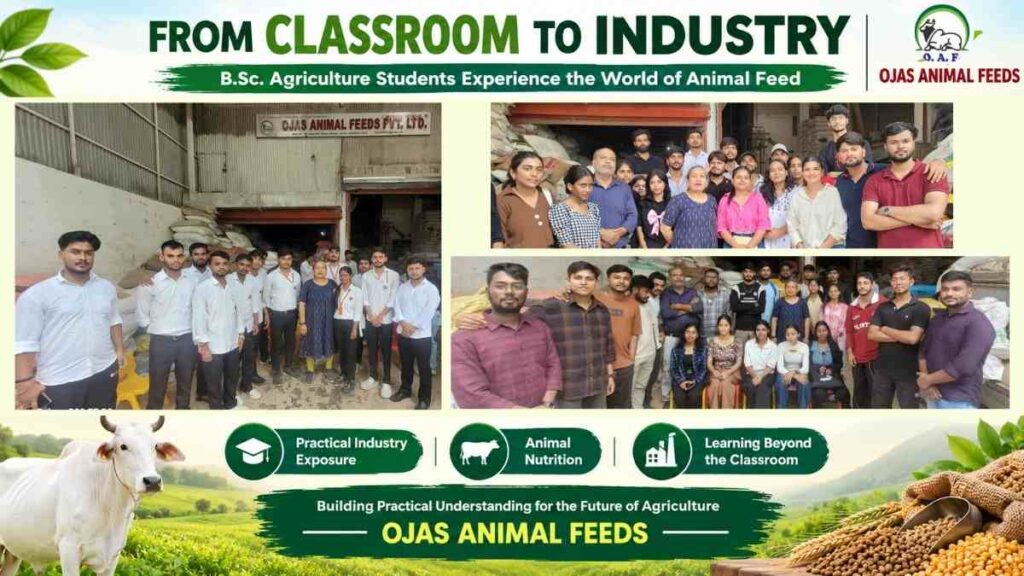
From Classroom to Industry: B.Sc. Agriculture Students Visit Ojas Animal Feeds for Industrial Training
Agriculture education is not limited to classrooms, textbooks, and examinations.
For students pursuing B.Sc. Agriculture, understanding how agricultural industries operate in the real world is an important part of developing practical knowledge.
Industrial training provides students with an opportunity to step beyond theoretical learning and observe professional processes, equipment, quality practices, and industry operations firsthand.
As part of their industrial training, B.Sc. Agriculture students from various colleges visited Ojas Animal Feeds, gaining practical exposure to the animal feed industry and its role in modern farming.

Bringing Agricultural Education Closer to the Industry
Agriculture is a broad field that connects farming, livestock, nutrition, technology, business, and food production.
While academic courses introduce students to these subjects, an industrial visit allows them to see how some of these concepts are applied in an actual working environment.
For agriculture students, visiting an animal feed manufacturing facility can provide a different perspective on the connection between Animal Nutrition and livestock management.

Understanding the Animal Feed Industry
During industrial training, students can gain an insight into the different stages involved in the feed industry.
From raw material handling and feed formulation to processing, packaging, storage, and quality-related practices, the industry involves multiple interconnected processes.
Seeing these operations in person can help students understand how agricultural knowledge moves from theory into practical application.
Learning Beyond the Classroom
One of the biggest advantages of industrial training is the opportunity to observe professionals at work.
Students can see how teams manage different stages of production and how various processes work together to create a finished feed product.
This kind of exposure can help students better understand concepts they may have previously encountered only through academic study.
It also allows them to ask questions and connect their classroom learning with real-world agricultural practices.

Exploring Animal Nutrition in Practice
Animal Nutrition is an important part of livestock farming.
Different farm animals have different nutritional requirements, and understanding these requirements is essential when developing suitable feed solutions.
During their visit to Ojas Animal Feeds, students could explore how the feed industry contributes to this aspect of farming and how nutrition is considered within feed production.
For agriculture students, such exposure can provide valuable context for subjects related to livestock, feed management, and farm production systems.
Understanding the Importance of Quality
Quality is an important consideration throughout the feed manufacturing process.
Students visiting an industrial facility can observe how organised production systems, handling procedures, storage practices, and quality-related processes contribute to the final product.
These observations can help students appreciate why consistency and responsible practices matter in the Animal Feed Industry.
Connecting Agriculture With Career Opportunities
Industrial training can also help students understand the wide range of career paths available within agriculture.
The agricultural sector extends far beyond crop cultivation.
Students can explore opportunities related to:
- Animal Nutrition
- Feed Manufacturing
- Quality Management
- Agricultural Technology
- Livestock Management
- Production
- Research and Development
- Sales and Marketing
- Farm Advisory Services
Exposure to different industries can help students make more informed decisions about their future areas of interest.
The Value of Industry-Academia Interaction
Visits like these create an opportunity for interaction between educational institutions and the agricultural industry.
Students gain practical exposure, while industries get an opportunity to interact with the next generation of agriculture professionals.
Such interactions can help bridge the gap between academic learning and practical application.
For agriculture as a sector, developing students who understand both concepts and real-world operations can be valuable for the future.
Ojas Animal Feeds: Supporting Learning Through Exposure
At Ojas Animal Feeds, we recognise the importance of practical exposure for students pursuing agricultural education.
The visit of B.Sc. Agriculture students from various colleges provided an opportunity to introduce young agriculture professionals to the functioning of the feed industry and its connection with livestock farming.
Ojas Animal Feeds works with feed solutions for different farm animals, including cattle, buffaloes, goats, sheep, horses, poultry, swine, rabbits, and other livestock categories.
The interaction gave students an opportunity to see how an animal feed company operates beyond what they may encounter in textbooks.
A Learning Experience That Goes Beyond One Visit
An industrial training visit is more than a tour of a facility.
It can encourage students to observe, ask questions, understand processes, and think about how their academic knowledge can be applied professionally.
For B.Sc. Agriculture students, experiences like these can become useful stepping stones as they continue their education and prepare for careers within the agricultural sector.
Final Thoughts
Agriculture is an industry that is constantly evolving, and tomorrow’s agricultural professionals are today’s students.
Giving B.Sc. Agriculture Students opportunities to experience the industry firsthand can help connect academic knowledge with practical understanding.
The industrial training visit to Ojas Animal Feeds was an opportunity for students from various colleges to explore the Animal Feed Industry, learn about Animal Nutrition, and gain a closer look at the processes involved in an agricultural business.
From Classroom Learning to Industry Experience — Building Practical Understanding for the Future of Agriculture. 🌾🎓🐄