
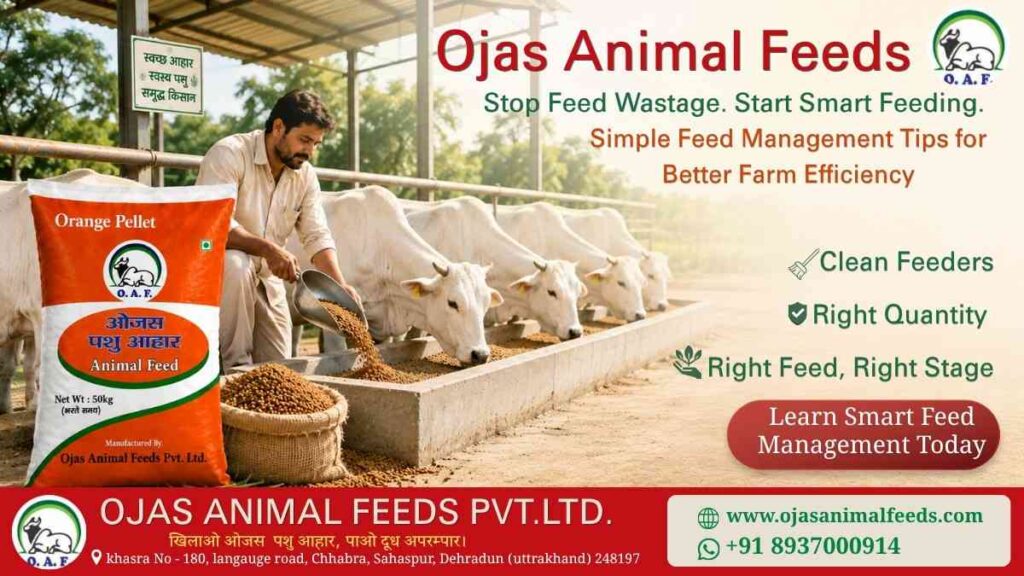
Feed is one of the most important inputs on any livestock farm.
Whether a farmer is raising cattle, goats, sheep, pigs, horses, rabbits, or poultry, providing appropriate nutrition is an essential part of animal management. But while farmers often focus on choosing the right feed, one important issue can sometimes be overlooked:
How much of the feed is actually being consumed?
Feed that is spilled, contaminated, improperly stored, or offered in unsuitable quantities can become wastage. Over time, even small amounts of daily wastage can add up and increase farm expenses.
Reducing feed wastage doesn’t necessarily mean feeding less. Instead, it means managing feed more intelligently so that the available nutrition is used as efficiently as possible.
At Ojas Animal Feeds, we believe that good livestock management involves both quality feed and responsible feeding practices. Here’s an educational guide to help farmers understand the common causes of feed wastage and practical ways to reduce them.
- Understand the Difference Between Feeding and Overfeeding
More feed does not automatically mean better nutrition.
Animals have different nutritional requirements depending on factors such as:
- Species
- Age
- Body size
- Growth stage
- Production stage
- Activity level
- Reproductive status
- Overall condition
Providing substantially more feed than required can increase wastage while making feeding costs unnecessarily high.
Farmers should follow appropriate feeding recommendations and adjust feeding programmes according to the animal’s stage and condition.
The objective should be:
Right feed + appropriate quantity + proper management.
- Choose Feed According to the Animal
One of the most important principles of Animal Nutrition is understanding that different animals have different requirements.
A growing goat does not have exactly the same nutritional requirements as a lactating sow.
Similarly:
- Poultry requires poultry-specific feed.
- Goats require goat-appropriate nutrition.
- Horses require horse feed.
- Pigs require swine feed.
- Rabbits have their own nutritional requirements.
- Dairy animals have different requirements depending on production.
Using feed according to the intended animal and production stage helps farmers create a more organized feeding programme.
- Store Feed Properly
Feed wastage doesn’t always happen at the feeding trough.
It can begin in the storage area.
Poor storage conditions may expose feed to moisture, pests, contamination, or other environmental problems.
Farmers should ideally store feed:
- In a clean area
- In a dry environment
- Away from direct moisture
- Away from pests
- Off the floor where appropriate
- In properly closed packaging or containers
Good storage is an important part of Livestock Feed Management.
- Keep Feed Away From Moisture
Moisture can be particularly problematic when storing animal feed.
Wet or damp storage conditions can affect feed quality and may encourage unwanted microbial growth.
During the monsoon season, farmers should be particularly attentive to:
🌧️ Leaking roofs
💧 Damp floors
🌫️ High humidity
📦 Wet packaging
🚪 Poorly ventilated storage areas
Regularly inspect the storage area and address moisture problems quickly.
- Avoid Overfilling Feeders
Overfilling a feeder may seem convenient because it reduces the number of times the farmer needs to refill it.
However, excessive feed in a trough can increase:
- Spillage
- Contamination
- Trampling
- Unnecessary leftovers
Instead of simply filling the feeder to capacity, farmers should consider how much feed the animals are actually consuming.
Monitoring intake can help establish a more appropriate feeding routine.
- Keep Feeding Areas Clean
A clean feeding area is important for both hygiene and feed management.
Feed that falls onto dirty or wet surfaces may become unsuitable for consumption.
Regularly inspect:
- Feed troughs
- Feeders
- Surrounding floors
- Storage containers
- Feeding equipment
Remove contaminated or spoiled material appropriately rather than mixing it back into fresh feed.
- Check Feeders for Damage
Sometimes feed wastage happens because of the equipment being used.
Broken or poorly positioned feeders can allow feed to fall onto the ground.
Check for:
- Cracks
- Broken edges
- Loose sections
- Excessively wide openings
- Unstable positioning
A well-maintained feeding setup can help reduce unnecessary loss.
- Monitor Leftover Feed
Leftover feed can provide useful information.
If a farmer repeatedly finds large amounts of feed remaining after feeding, it may be worth investigating why.
Possible reasons include:
Excessive feeding quantity
- Poor feed acceptance
- Sudden feed changes
- Incorrect feeding schedule
- Competition between animals
- Health-related issues
Instead of simply throwing away leftovers every day, farmers should look for patterns.
Observation is an important part of good farm management.
- Don’t Ignore Feed Competition
When multiple animals share a feeding area, stronger or more dominant animals may consume more while others get less access.
This can create two problems:
- Some animals may not receive adequate access to feed.
- Feed may be pushed or spilled during competition.
Farmers should consider whether the number and design of feeders are suitable for the animals being managed.
Providing adequate feeding space can make feeding more organized.
- Make Feed Changes Gradually
Sudden changes in feeding programmes can sometimes affect animal acceptance and digestive adaptation.
Whenever a feeding programme needs to change, farmers should follow appropriate transition practices and professional recommendations.
Gradual changes, where appropriate, can make it easier to observe how animals respond to a new feeding programme.
If there are concerns about appetite, digestion, or animal health, consult a qualified veterinarian or animal nutrition professional.
- Keep an Eye on Feed Quality
Good Farm Feed Efficiency starts with feed that is suitable for its intended purpose.
Before feeding, farmers should observe the feed for obvious issues such as:
- Unusual odour
- Visible contamination
- Excessive moisture
- Damaged packaging
- Pest infestation
- Unusual appearance
If something appears abnormal, don’t simply assume that the feed is suitable for use.
Follow the manufacturer’s guidance and seek professional advice when necessary.
- Maintain a Feed Inventory
Farmers can reduce avoidable losses by keeping track of how much feed enters and leaves the storage area.
A simple record can include:
Record Information
Feed purchased Quantity received
Date received Purchase date
Feed used Daily/weekly usage
Remaining stock Current quantity
Damaged feed Quantity lost
Wastage Estimated loss
This simple system can help identify unusual consumption patterns.
It also makes it easier to plan future purchases.
- Use the First-In, First-Out Principle
A useful storage practice is FIFO — First In, First Out.
This means older feed is used before newly purchased stock, wherever appropriate and consistent with the product’s storage and shelf-life instructions.
Instead of placing every new bag at the front of the storage area, organize stock so older suitable feed can be accessed first.
This can help reduce the risk of products being forgotten at the back of storage.
- Don’t Buy More Than You Can Store Properly
Buying feed in large quantities may sometimes appear economical.
However, if the farm doesn’t have appropriate storage conditions, excessive stock can create unnecessary risks.
Before purchasing large quantities, consider:
- Available storage space
- Storage conditions
- Expected usage
- Product shelf life
- Protection from moisture and pests
- Frequency of feed deliveries
Good purchasing decisions are part of effective Livestock Feed Management.
- Observe Animals While They Eat
Farmers can learn a lot simply by watching their animals during feeding.
Look for:
- Whether animals approach the feeder normally
- Whether some animals dominate feeding areas
- Whether feed is being spilled
- Whether animals leave significant amounts behind
- Whether animals show unusual changes in appetite
- Regular observation can help farmers identify problems earlier.
Feeding management isn’t just about the feed bag. It’s also about understanding the animals.
- Don’t Confuse Feed Wastage With Animal Health Problems
Sometimes reduced feed consumption isn’t a feed-management problem.
An animal that suddenly stops eating or shows a significant change in behaviour may have an underlying health issue.
Farmers should not simply increase or decrease feed quantities without understanding the reason.
If an animal shows:
- Sudden appetite changes
- Unusual behaviour
- Digestive problems
- Weakness
- Significant changes in condition
professional veterinary advice should be sought.
- Feed According to the Production Stage
Stage-specific feeding is particularly important in organized livestock farming.
Animals can have very different nutritional requirements during different stages.
For example, swine feeding programmes may include:
🐖 Starter
🐖 Grower
🐖 Maintenance
🐖 Gestation
🐖 Lactation
Similarly, other livestock species have their own stage-specific feeding requirements.
Using an appropriate Quality Animal Feed according to the animal and its stage can make the overall feeding programme more structured.
- Why Reducing Feed Wastage Matters
Reducing wastage isn’t simply about saving feed.
It can help farmers improve several aspects of farm management.
Better Cost Management
Less unnecessary wastage means more of the purchased feed is actually utilized.
Better Inventory Planning
Accurate usage records make it easier to plan future purchases.
Cleaner Feeding Areas
Reduced spillage can contribute to better farm hygiene.
More Organized Feeding
Monitoring feed intake creates a more structured routine.
Better Resource Utilization
Making better use of available feed is an important part of responsible farming.
- A Simple Daily Feed Management Checklist
Farmers can use a simple daily checklist.
Before Feeding
☑️ Check the feed
☑️ Inspect the feeder
☑️ Confirm the appropriate feed
☑️ Check the feeding area
During Feeding
☑️ Observe animal behaviour
☑️ Watch for excessive spillage
☑️ Check feeding competition
☑️ Monitor consumption
After Feeding
☑️ Check leftover feed
☑️ Clean the feeding area
☑️ Record unusual observations
☑️ Store remaining feed properly
This routine doesn’t require complicated equipment.
It requires consistency.
Why Ojas Animal Feeds?
At Ojas Animal Feeds, we understand that livestock farmers manage different species and production stages.
Our range includes animal feed solutions for:
🐄 Cattle
🐐 Goats
🐖 Pigs
🐎 Horses
🐇 Rabbits
🐑 Sheep
🐔 Poultry
Our goal is to provide farmers with quality animal nutrition solutions while encouraging informed and responsible feeding practices.
The Ojas Animal Feeds Difference
Good livestock farming requires more than simply purchasing feed.
It involves understanding the animal, choosing appropriate nutrition, maintaining clean feeding conditions, storing products correctly, and monitoring consumption.
At Ojas Animal Feeds, we believe farmers should have access to feeding solutions that support organized farm management across different animal categories.
Quality Animal Feed + Smart Management = Better Feed Utilization.
Final Thoughts
Feed is one of the most important resources on a livestock farm, which makes reducing unnecessary wastage an important part of responsible farm management.
Farmers can begin with simple habits:
- Store feed properly.
- Keep feeders clean.
- Avoid unnecessary overfilling.
- Monitor leftovers.
- Choose feed according to the animal and production stage.
- Observe animals regularly.
- Maintain basic feed records.
These practices may seem small individually, but together they can make feeding routines more organized and efficient.
Most importantly, remember that good Animal Feed Management isn’t about giving animals less feed.
It is about making sure the right feed reaches the right animal, in the right quantity, at the right stage, with minimum unnecessary loss.
At Ojas Animal Feeds, we remain committed to supporting farmers with quality animal nutrition solutions for different livestock and poultry needs.
Better Feed Management. Better Resource Utilization. Better Farming.