
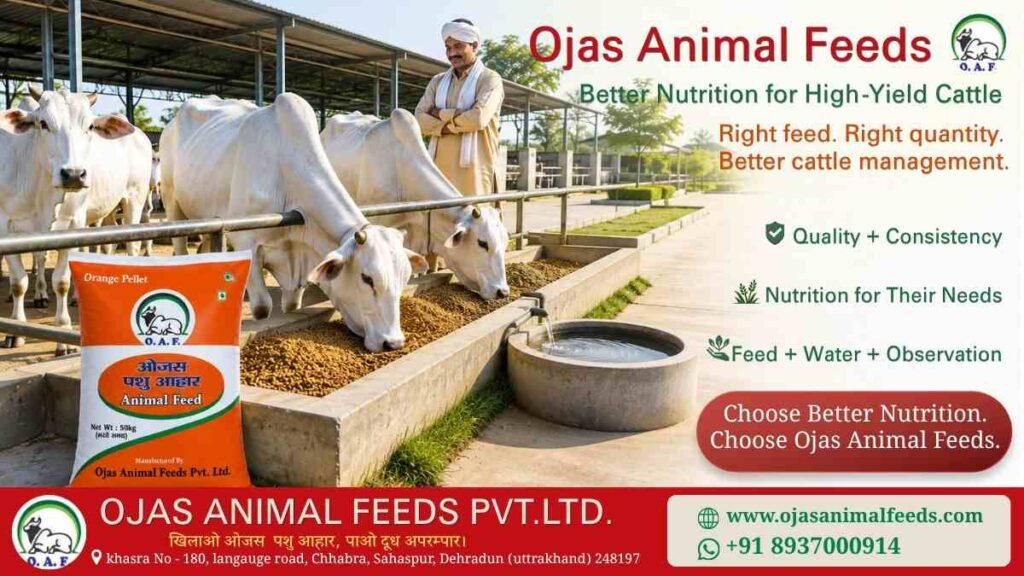
Dairy Cow Feed plays an important role in maintaining healthy and productive cattle, especially on farms managing high-yield dairy cows. While clean water, comfortable housing, hygiene and regular veterinary care all matter, appropriate feed remains an important part of a dairy animal’s daily routine.
High-yield dairy cows have different nutritional requirements from animals that are not producing milk. Their feeding programme needs to support their overall condition while providing appropriate nutrition during the production stage.
Choosing the right cattle feed is therefore not simply about providing more feed. It is about providing appropriate nutrition in the right quantity, maintaining consistency and considering the animal’s overall diet and condition.
At Ojas Animal Feeds, we focus on scientifically formulated, urea-free animal feed solutions designed to support healthier and more productive livestock. Our range includes Ojas Brown Mesh Feed, a 100% urea-free feed formulated for high-yield dairy cows.
Let’s understand the important factors farmers should consider when managing nutrition for high-yield dairy cows.
Why Is Cattle Feed Important for Dairy Cows?
Dairy cows require appropriate nutrition for their everyday maintenance as well as milk production.
The nutritional requirements of a cow can vary depending on several factors, including:
- Age
- Body condition
- Breed
- Milk production
- Stage of lactation
- Reproductive status
- Activity level
- Overall health
- Quality of available forage
This means there is no single feeding approach that is ideal for every animal.
A well-planned feeding programme should consider the individual animal and the complete diet rather than relying on one feed product alone.
Understanding the Needs of High-Yield Dairy Cows
High-yield dairy cows require attentive nutritional management because milk production places additional demands on the animal.
Farmers should monitor their cattle regularly and consider changes in:
- Feed intake
- Water consumption
- Milk production
- Body condition
- Activity
- General behaviour
- Digestive health
A sudden change in appetite, milk production or behaviour should not simply be addressed by increasing feed. Farmers should investigate possible causes and seek professional veterinary or animal nutrition advice when necessary.
Good feeding begins with observation.
What Makes Good Cattle Feed?
When selecting cattle feed, farmers should consider more than just the price or appearance of the product.
Important factors include:
Appropriate Nutrition
The feed should be suitable for the animal and its production stage.
A high-yield dairy cow may have different nutritional requirements from a dry cow, growing calf or non-lactating animal.
Consistent Quality
Consistency is important in livestock feeding.
Farmers should choose products from reliable manufacturers and follow the recommended feeding instructions.
Suitable Ingredients
Understanding the ingredients and nutritional information of a feed product can help farmers make informed decisions about how it fits into the overall diet.
Proper Formulation
Scientifically formulated feed can help farmers create a more structured feeding programme when used appropriately alongside forage and other components of the diet.
Cattle Feed Should Be Part of a Complete Diet
One of the most important things to remember is that concentrate cattle feed should not automatically be considered the entire diet.
Dairy cattle may receive different sources of nutrition, including appropriate green fodder, dry fodder, forage and concentrate feed depending on the farm’s feeding system.
The overall diet should be considered as a whole.
Farmers should avoid making major changes to the animal’s diet suddenly. Any change in feeding should be managed carefully and according to appropriate recommendations.
The Importance of Clean Drinking Water
Good cattle nutrition does not stop with feed.
Fresh, clean drinking water should always be available to dairy animals.
Water and feed work together as important parts of livestock management. Farmers should regularly check water containers, keep them clean and make sure animals can access water comfortably.
Clean water is particularly important when animals are consuming dry feed or during periods of warmer weather.
Ojas Animal Feeds also emphasizes that quality feed and clean water should work together as part of responsible livestock management.
Feed According to the Cow’s Production Stage
Not every cow on a dairy farm requires the same feeding programme.
Lactating Cows
Cows producing milk require careful nutritional management. Their feeding programme should be planned according to factors such as milk production, body condition and the rest of their diet.
Dry Cows
Dry cows have different nutritional requirements from actively lactating animals. Their feeding programme should be adjusted accordingly.
Growing Animals
Young cattle require appropriate nutrition to support their growth and development.
High-Yield Dairy Cows
High-yielding animals require particularly attentive management because their production level can influence their nutritional requirements.
This is why selecting cattle feed according to the animal’s production stage is more appropriate than using exactly the same feed programme for every animal.
Why Urea-Free Feed Matters
Ojas Animal Feeds has built its brand around a urea-free animal feed approach.
The company describes its products as 100% urea-free and focuses on providing nutritious feed solutions for different livestock categories.
For farmers considering cattle feed, understanding what a product contains and following its recommended usage is important.
Rather than choosing feed based only on marketing claims, farmers should look at the product information, nutritional specifications and suitability for their animals.
How to Manage Cattle Feed Properly
Choosing quality feed is only one part of good feeding management.
Maintain a Regular Routine
Feeding cattle at consistent times can make daily farm management more organized.
A regular routine also makes it easier to notice changes in appetite and behaviour.
Measure Feed Appropriately
More feed does not automatically mean better nutrition.
Providing excessive quantities can increase wastage and unnecessarily increase feeding costs.
Feed quantities should be determined according to the animal’s requirements and the overall feeding programme.
Keep Feeding Areas Clean
Feeders and feeding areas should be kept clean.
Regular cleaning can help maintain better hygiene and reduce unnecessary contamination.
Monitor Leftovers
Check what remains after feeding.
Consistently large amounts of leftover feed may indicate that the quantity, palatability, feeding routine or other conditions need to be reviewed.
Avoid Sudden Changes
Sudden changes in diet can create unnecessary challenges for livestock.
When introducing a new feed, farmers should follow the manufacturer’s recommendations and make changes appropriately.
Proper Feed Storage Is Essential
Even good-quality cattle feed needs to be stored correctly.
Poor storage can expose feed to moisture, pests and contamination.
Farmers should ideally keep feed:
- In a clean and dry area
- Away from direct moisture
- Protected from pests
- Away from direct sunlight
- Off damp floors
- In properly closed bags or containers
During the monsoon and periods of high humidity, storage conditions deserve additional attention.
Regularly inspect the storage area for leaks, dampness and damaged packaging.
Good storage is an important part of maintaining feed quality until it is ready to be used.
Observe Your Dairy Cows Every Day
Farmers don’t need complicated technology to learn a lot about their animals.
Daily observation can provide useful information.
Pay attention to:
- Appetite
- Water intake
- Activity
- Feeding behaviour
- Body condition
- General appearance
- Milk production
- Changes in routine
If a cow suddenly stops eating, appears unusually weak, shows a significant change in behaviour or experiences an unexpected change in milk production, professional veterinary advice should be sought.
Feed should not be used as a substitute for veterinary care.
Reducing Cattle Feed Wastage
Feed wastage can increase farm expenses without providing any nutritional benefit.
Farmers can reduce unnecessary wastage by following simple practices.
Avoid overfilling feeders, keep feed protected from moisture, store bags correctly and observe how much feed animals actually consume.
A simple daily record can also help.
Farmers can note:
- Amount of feed provided
- Approximate leftovers
- Feeding time
- Changes in appetite
- Milk production
- Unusual observations
Over time, these records can help farmers understand patterns and make more informed management decisions.
Why Ojas Brown Mesh Feed?
Ojas Animal Feeds offers Ojas Brown Mesh Feed, described on its website as a premium-quality, 100% urea-free animal feed specially formulated for high-yield dairy cows. It is available in 50 kg packaging.
The product is part of Ojas Animal Feeds’ wider range of nutrition solutions developed for different livestock categories.
The company also provides customized feed solutions and nutrient-enriched formulations designed around the nutritional needs of livestock.
For dairy farmers, the key is to select feed according to the animal’s requirements and use it as part of a complete and well-managed feeding programme.
A Simple Daily Cattle Feeding Checklist
Farmers can use this simple checklist as part of their daily routine:
Before feeding:
- Check the feed and packaging.
- Make sure the feeding area is clean.
- Confirm the feed is appropriate for the animals.
- Check that clean water is available.
During feeding:
- Observe the animals.
- Monitor feed intake.
- Look for excessive competition or spillage.
- Check that animals can access the feed comfortably.
After feeding:
- Observe leftovers.
- Clean the feeding area when required.
- Store remaining feed properly.
- Record unusual changes in appetite or behaviour.
These small habits can make daily livestock management more organized.
Better Feed Management Means Better Farm Management
Successful dairy farming isn’t based on one factor.
It is a combination of appropriate nutrition, clean water, good housing, hygiene, regular observation, responsible feeding and veterinary care.
Cattle feed plays an important role within this larger system.
For high-yield dairy cows, farmers should focus on understanding the animal’s requirements rather than simply increasing the amount of feed.
The goal should be simple:
Right feed + appropriate quantity + clean water + consistent management.
Why Choose Ojas Animal Feeds?
Ojas Animal Feeds focuses on providing 100% urea-free animal feed and nutrition solutions for multiple livestock categories, including cattle, goats, horses, swine, poultry, sheep and rabbits.
The company’s approach combines scientifically formulated feed solutions with practical support for farmers.
With dedicated products for different animals and production stages, Ojas aims to help farmers make more informed feeding decisions and maintain consistent livestock management.
Final Thoughts
Choosing the right cattle feed is an important decision for every dairy farmer, especially when managing high-yield animals.
However, good nutrition is not about simply providing more feed. It is about understanding the animal, considering its production stage, selecting appropriate nutrition and managing the complete diet responsibly.
Clean water, proper storage, hygienic feeding areas, regular observation and consistent feeding routines should all work alongside quality feed.
For farmers looking for a dedicated solution for high-yield dairy cows, Ojas Brown Mesh Feed is part of Ojas Animal Feeds’ 100% urea-free animal feed range.
At Ojas Animal Feeds, our goal is to support farmers with dependable animal nutrition solutions and practical knowledge for better livestock management.
Better Nutrition. Better Management. Better Farming. Choose Ojas Animal Feeds.